
Animals that use echolocation can sense vibrations to locate distant objects. Animals with infrared vision can sense a kind of light that humans can’t see! Which would YOU rather have?
Back to Teacher View
Student View
Illustrations by Pete McDonnell
Would You Rather Have Echolocation or Infrared Vision?
If you had to pick one to be your superpower, which would you choose?
By Gayoung Lee | Illustrated by Pete McDonnell
From the February 2025 Issue
Learning Objective: Students will gather and use information about echolocation and infrared vision to support an argument.
Key Focus Area:
Sound, Light, and Other Waves,
Other Focus Areas: Energy, Adaptations, Measurement & Data
Standards

Would You Rather Have Echolocation or Infrared Vision?
Watch a video to help you make your choice.
ECHOLOCATION
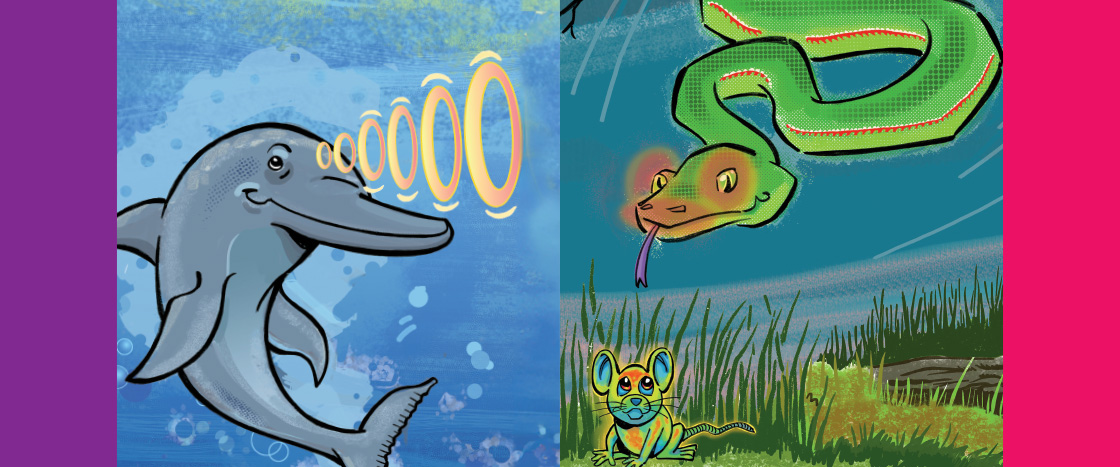
Dolphins send sound waves through the water. When these vibrations bounce back, they tell the dolphin what’s ahead.
HOW IT WORKS
An animal makes a high-pitched noise, sending a sound wave through air or water. The wave bounces off faraway objects and returns like an echo. Its shape tells the animal the objects’ distance, size, and even speed!
HOW IT’S HELPFUL
With echolocation, animals can find food, avoid obstacles, and detect predators that they can’t see. This is especially helpful for animals that are mostly active at night or that need to locate
far-away objects.
REAL-WORLD EXAMPLES
Dolphins and some whales move air through spaces in their head to make clicks. This helps them find fish to eat. Bats and a few types of birds let out noises as they fly. That allows them to find their way in the dark.
WITH THIS POWER...
You could locate and identify things that are difficult to see on land or in water. So if you were to drop your goggles while swimming in the ocean, you’d know just where to find them. What would you use echolocation for?
INFRARED VISION
Pit vipers use infrared vision to sense energy coming from other animals. That helps them find prey in total darkness.
HOW IT WORKS
Infrared light is a type of energy. The warmer something is, the more infrared light it gives off. Some animals have special organs that detect this energy. Their brain then forms colorful images of the objects called heat signatures.
HOW IT’S HELPFUL
With infrared vision, predators can find fast-moving prey in the dark and pinpoint the best spot to attack. Prey animals can use infrared vision to sense nearby predators so they can stay away from them.
REAL-WORLD EXAMPLES
Pit vipers’ jaws are lined with sensors that help them find animals to eat. Mosquitoes have organs that tell them the warmest places on an animal’s body. That’s where the blood is closest to the skin!
WITH THIS POWER...
You could detect anything that gives off heat no matter how dark it was around you. If your pet cat were to sneak outside at night, you could sense her heat signature and bring her home. What would you use infrared vision for?
What does your class think?
Which would you rather have?
Which would you rather have?
Which would you rather have?
0%
0votes
{{result.answer}}
Total Votes: 0
video
(1)
Games
(2)
Games
(2)
Activities
(3)
Question & Answer Sheets
Skills Activities
Answer Key
(1)
Step-by-Step Lesson Plan
1. PREPARE TO READ (10 minutes)
Make an initial choice and explain the reasoning behind it.
- If needed, explain the “Would You Rather . . . ?” game. In this game, a person must make a tricky choice between two things. There isn’t a “right” answer, but you must choose one and defend your choice. Project the opening pages of the article, reading the captions aloud. Then ask students: Would you rather have echolocation or infrared vision? Let students record their initial choice and jot down one or two sentences about the reasoning behind their decision.
2. READ AND Evaluate (15 minutes)
Gather information and discuss text evidence.
- Play the video “Would You Rather Have Echolocation or Infrared Vision?” Give students time to change their choice and/or add any new information from the video to their reasoning. Designate one side of the room “echolocation” and the other side “infrared vision.” Tell students they’re allowed to change their mind later, but for now they should go to the side that matches their choice. Do a quick tally of each side and record it on the board. Then have students return to their seats.
- Read the article aloud or have students read it independently. Compare sections with the same titles, like “How It Works” and “How It’s Helpful.” Ask: What information did you find most surprising or interesting? (e.g., There’s a kind of light people can’t see.) Let students discuss in pairs. Then reconvene as a class and ask for volunteers to share.
- Ask: Did your original choice change? If so, why? Remind students that new information can change one’s mind—and that’s OK! As we learn more, our thinking often changes.
3. RESPOND TO READING (20 minutes)
Write and evaluate an evidence-based opinion.
- Tell students it’s final-decision time! Preview the Explain Your Choice activity. Have students discuss and complete step 1 in groups. Then briefly discuss as a class. Afterward, have students complete step 2 independently.
- Tally students’ final choices. Record the results on the board. If desired, have students complete the “Take It Further!” prompt to draw a comic strip or write a narrative where they imagine themselves having and using one of these senses. Have students share their final pieces with a small group and discuss why they chose that sense.
Text-to-Speech