
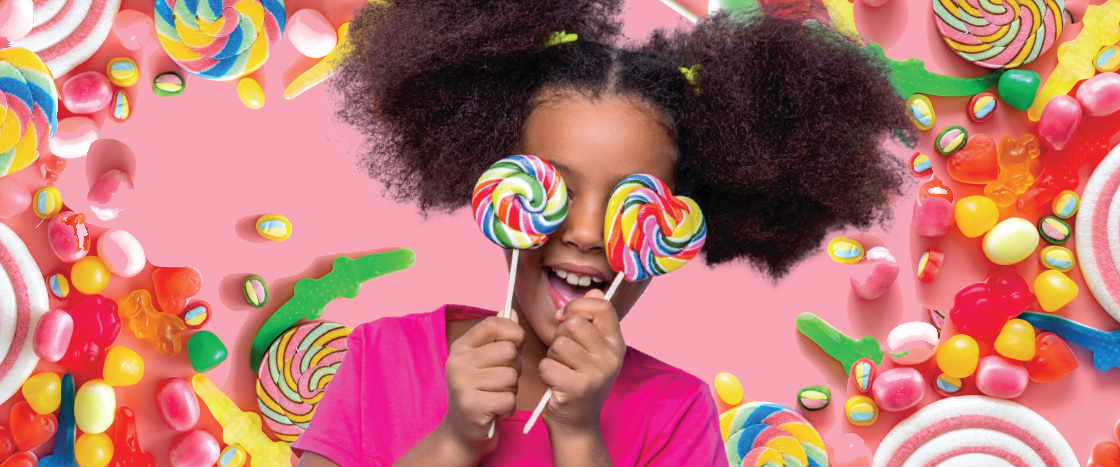
Trick-or-treating on Halloween. A box of sweets at the movies. People love to give and get candy! But how is it made? And when did people start making it? Candy’s sweet story might surprise you!
Back to Teacher View
Student View
Shutterstock.com
Candy Craze
Candy's sweet story might surprise you!
By Elizabeth Carney
From the October/November 2025 Issue
Learning Objective: Students will summarize how candy is made and investigate properties of candy.

How Jelly Beans Are Made
Watch a video about the process of making jelly beans
Ancient Recipes
Shutterstock.com
Humans have been making candy for at least 3,000 years. Ancient Egyptians made treats with honey and fruit or nuts. Sugar, from the plant sugarcane, was first used in candy making about 1,500 years ago. Whether using honey or sugar, early candymakers often flavored their treats with plants such as ginger or licorice.
For centuries, people viewed candy as a type of medicine. They ate sweet treats made with herbs and spices as a remedy for a sore throat or an upset stomach.
Starting with Syrup
Borthwick Institute/Heritage Images/Getty Images
A candymaker stirs a boiling mixture in 1925.
From caramels to jelly beans to gummy bears, all candies have one thing in common—sugar!
Candymakers start by boiling sugar and water together, creating a syrup. The final temperature of the syrup determines the candy’s properties once it cools.
While the syrup cooks, candymakers might add ingredients that thicken the mixture, such as cornstarch. They also add flavors, which are substances that make the candy taste fruity, sour, or spicy.
Temperature Control
Shutterstock.com
Candymakers use a tool called a candy thermometer to carefully measure and control the temperature of candy syrup. The texture of the cooled candy depends on how much the mix was heated. Each type of candy has a different name and a target temperature to reach during cooking.
SHUTTERSTOCK.COM
340°F (171°C)
Dark Caramel
Dark reddish-brown syrup
Example: Caramel sauce
SHUTTERSTOCK.COM
300°F (149°C)
Hard Crack
Has a glassy texture that’s brittle and can be snapped
Example: Lollipop
SHUTTERSTOCK.COM
270°F (132°C)
Soft Crack
Has a chewy texture and is slightly bendable
Example: Taffy
SHUTTERSTOCK.COM
250°F (121°C)
Hard Ball
Forms a firm ball when dripped into cool water
Example: Gummy bear
SHUTTERSTOCK.COM
235°F (113°C)
Soft Ball
Forms a squeezable ball when dripped into cool water
Example: Fudge
How Candy Feels
Shutterstock.com
Candies come in many textures that affect the way they feel when eaten. Hard candies are made to dissolve, or become part of a liquid, in your mouth. On the other hand, your jaws get a workout chewing taffy. A bite of cotton candy feels like eating a sweet ball of fluff. It’s made by spinning sugar syrup at high speeds into airy strands.
Making with Machines
Monty Rakusen/Digital Vision/Getty Images
For most of candy’s history, people made it by hand. In the 1700s and 1800s, machines were invented that made candy making easier and cheaper. Candy stores became a popular spot for children to buy sweets for only a few pennies.
Today candymakers continue to dream up new flavors and types of treats—such as crunchy freeze-dried candies and peelable gummies! If you could invent a new type of candy, what would you create?
STEM in a Snap: Investigating Candy
Watch a video that demonstrates an experiment
video
(2)
video
(2)
Activities
(4)
Question & Answer Sheets
Skills Activities
Answer Key
(1)
Step-by-Step Lesson Plan
1. PREPARE TO READ (10 minutes)
Watch a video and consider what can cause differences between candies.
- ASK: What is your favorite candy? Why? How are candies different? (e.g., textures, flavors) What could cause those differences? (e.g., different ingredients and production methods) Choose a few volunteers to share their responses.
- Play the video “How Jelly Beans Are Made.” Ask students to watch for other things that give candies their different properties (e.g., the temperature at which it’s cooked affects candy’s texture). After viewing, discuss students’ ideas.
2. READ AND ANALYZE (20 minutes)
Use an article and map to compare candy’s history with its present and future.
- Tell students they’re going to find out more about candy’s properties and its history. Read the article aloud or have students read it independently.
- ASK: What were the first candies made of? (honey, fruit, and nuts) Does candy today still use those ingredients? (Sugar is more common now, but some candy includes nuts or fruit flavors.)
- Project the State Favorites map. ASK: What does this map show? (The most popular candy bought in each state before Halloween in 2024) Do you think that is a good time to gather data about candy popularity? (e.g., Yes, because a lot of candy is sold right before Halloween for trick-or-treating.)
- Let students share what they notice about the map, then have them answer the “Data Detective” questions in the magazine. (See the “STEM Integration” section to extend students’ learning with additional map questions.)
3. RESPOND TO READING (30-60 minutes)
Explore candy’s properties further with hands-on investigations.
- Note: The Investigating Candy activity has two parts: Part 1 is an investigation where students observe three different types of candy in water. Part 2 provides the opportunity for students to plan their own investigation. You can have students do both parts or just one. Play the “STEM in a Snap: Investigating Candy” video to guide students through Part 1 and provide inspiration for Part 2.
- Tip: We selected our candies—Life Savers, jelly beans, and peach rings—for their differences in hardness and texture. We did not use chocolate. You can provide the same three types of candies for all students or offer more variety. Before distributing the activity sheet and materials, remind students that this candy is for the experiment—no tasting!
- Have students work in small groups. If you’re doing both parts of the activity, while students wait for their candy to soak in Part 1, they can work on Part 2. Reconvene to discuss their results and conclusions.
Text-to-Speech