
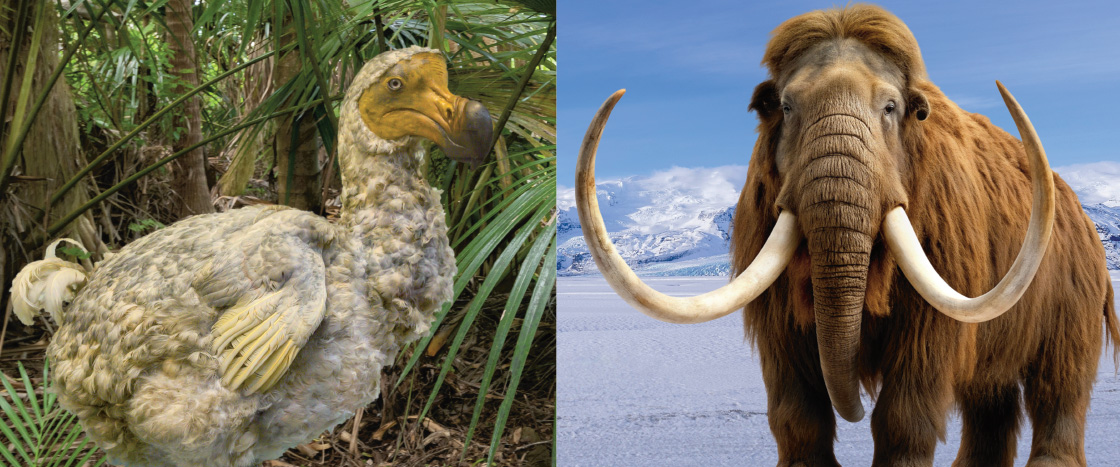
A squat, round bird that waddled to get around. An elephant-like mammal with shaggy fur and enormous tusks. Both animals died out long ago. Which would you choose to bring back from extinction?
Back to Teacher View
Student View
Shutterstock.com
Would You Rather Bring Back the Dodo Bird or the Woolly Mammoth?
Which species would you bring back from extinction?
By Jess McKenna-Ratjen
From the October/November 2025 Issue
Learning Objective: Students will gather and use information about two extinct animals to support an argument.
Key Focus Area:
Evolution and Natural Selection,
Other Focus Areas: Ecosystems, Human Impacts, Measurement & Data
Standards

Would You Rather Bring Back the Dodo Bird or the Woolly Mammoth?
Watch a video to help you make your choice
DODO BIRD
Daniel Eskridge/Stocktrek Images/Science Source
The dodo was about 3 feet tall and weighed up to 50 pounds. Its wings were too tiny for it to fly!
WHEN AND WHERE THEY LIVED
Jim McMahon/Mapman®
The first dodos lived several million years ago. They became extinct sometime around 1690 A.D. They lived only on the African island of Mauritius (maw-RIH-shuhs), in the Indian Ocean. Mauritius has dense rainforests, rocky cliffs, and white sand beaches.
WHAT THEY WERE LIKE
Dodos are related to today’s pigeons. But unlike pigeons in the U.S., dodos on Mauritius had no natural predators! Their ancestors didn’t need to fly to escape being hunted. So over many generations, their wings became tiny. Their bodies evolved short, thick legs. Dodos used their large beaks to eat fruits and nuts.
WHY THEY BECAME EXTINCT
In 1598 A.D., Dutch sailors landed on Mauritius. Dodos weren’t used to being hunted, so they didn’t hide from humans and were easy to catch. Sailors reported that the birds tasted oily and gross. But the rats that snuck on and off the sailors’ ships loved to eat dodo eggs. Within 100 years of humans’ first recorded sighting of a dodo, the birds were all gone.
REASONS TO BRING THEM BACK
Bringing back the dodo could help the ecosystem of Mauritius return to the way it was before humans changed it. Dodos spread seeds in their droppings, helping forests thrive. Today the government of Mauritius is taking steps to remove invasive species, like rats, and to allow some of its farmland to become wild again. If we brought dodos back, could they help these wild areas grow?
WOOLLY MAMMOTH
MARK GARLICK/Science Source
Woolly mammoths could reach 12 feet in height and weighed about 8 tons. That’s heavier than four cars!
WHEN AND WHERE THEY LIVED
Woolly mammoths evolved about 300,000 years ago. By 2000 B.C., they were extinct. They lived during the Ice Age, a time when northern Asia, Europe, and North America were mostly covered with snow and ice.
WHAT THEY WERE LIKE
Today’s elephants are adapted to warm climates. But their ancient cousins could survive temperatures as low as -58°F (-50°C)! Woolly mammoths had two layers of thick fur. They also had giant tusks—each 15 feet (4.5 meters) long—to dig food like leaves and twigs out of the snow.
WHY THEY BECAME EXTINCT
Woolly mammoths disappeared around the same time the Ice Age ended. Melting snow and ice turned the cold grasslands where mammoths lived into wetlands. Mammoths couldn’t find enough food and eventually died out.
REASONS TO BRING THEM BACK
Bringing back woolly mammoths could help protect the Arctic. How? When woolly mammoths were alive, they scraped up snow while eating. That allowed freezing air to chill the soil beneath. Today Earth is warming faster than ever, causing Arctic soil to thaw. Some scientists think woolly mammoths could protect this habitat by helping the soil stay frozen! But Earth has changed a lot in 4,000 years. Would mammoths survive?
What does your class think?
Which would you bring back?
Which would you bring back?
Which would you bring back?
0%
0votes
{{result.answer}}
Total Votes: 0
video
(1)
Games
(1)
Activities
(2)
Skills Activities
Answer Key
(1)
Step-by-Step Lesson Plan
1. PREPARE TO READ (10 minutes)
Make an initial choice and explain the reasoning behind it.
- If needed, explain the “Would You Rather . . . ?” game. In this game, a person must make a tricky choice between two things. There isn’t a “right” answer, but you must choose one and defend your choice.
- Project the opening pages of the article, reading the captions aloud. ASK: Would you rather bring back the dodo bird or the woolly mammoth? Let students record their initial choice and jot down one or two sentences explaining why.
2. READ AND EVALUATE (15 minutes)
Gather information and discuss text evidence.
- Play the video “Would You Rather Bring Back the Dodo Bird or the Woolly Mammoth?” Give students time to change their choice and/or add any new information from the video to their reasoning.
- Designate one side of the room “dodo bird” and the other side “woolly mammoth.” Tell students they’re allowed to change their mind later, but for now they should go to the side that matches their choice. Do a quick tally of each side and record it on the board. Then have students return to their seats.
- Read the article aloud or have students read it independently. Compare sections with the same titles, like “When and Where They Lived.” ASK: What information did you find most surprising or interesting? Let students discuss in pairs or small groups. Then reconvene as a class and ask for volunteers to share.
- ASK: Did your original choice change? If so, why? Remind students that new information can change one’s mind—and that’s OK! As we learn more, our thinking often changes.
3. RESPOND TO READING (20 minutes)
Write and evaluate an evidence-based opinion.
- Tell students it’s time to make their final decision! Preview the Explain Your Choice activity. Have students discuss and complete step 1 in groups. Briefly discuss as a class. Then have students complete step 2 independently.
- Tally students’ final choices. Record the results on the board.
- If desired, have students complete the “Take It Further!” prompt to draw a comic strip or write a narrative where they imagine what a typical day was like for one of these creatures. Allow them to share their final pieces with a partner.
Text-to-Speech